Frederick II Hohenstaufen,
Holy Roman Emperor (1194 – 1250)
Canto I:
The Sicilian Sun
Where sapphire seas in ancient embrace curled,
And Europe’s south met Afric’s sun-scorched world,
Rose Trinacria, isle of myth and fire,
Her soul a blend of longing and desire.
And ever present, brooding in the haze,
Etna arose, through centuries of days,
Her breath a plume, a restless, smoky crown,
A sleeping giant, threatening to drown
The fertile slopes in rivers hot and red,
A metaphor for tensions overhead,
Where Norman steel and Saracen design,
And Byzantine gold in strange embrace combine.
From Viking stock, the conquering Normans came,
And on this isle, they forged a kingdom’s name.
With laws well-wrought, where diverse tongues could speak,
And tolerance, a fragile, precious streak,
Allowed the scholar and the craftsman free,
Beneath the gaze of that volcanic see.
Yet older faiths, from starry skies above,
Still held their sway, a whispered, ancient love
Of zodiac signs and planetary dance,
Where human fate found cosmic circumstance.
The Arab’s wisdom, grafted onto Greek,
A tapestry of wonders, all would seek
To read the heavens, in that age of awe,
Before the reign of rigid, dogmic law.
Then Swabia’s shadow, through a marriage came,
A German lord, entwined with Sicily’s fame.
Henry the Sixth, his iron will would bind
This vibrant kingdom to a different kind
Of destiny. But Etna’s slumber deep,
Could not forever its hot secrets keep.
A tremor ran beneath the sun-kissed stone,
Foreshadowing conflicts yet unknown,
The clash of empires, north and south aligned,
A potent brew for future to unwind.
In this rich cradle, where the old did meet
The new, where earth exhaled a smoky heat,
A child was born, beneath a watchful star,
Whose nascent fate stretched wider, further far
Than island shores. No fanfare marked his entry,
Just life's first breath, within this vibrant country,
Where ancient lore and future’s veiled design,
Around his cradle subtly would entwine.
For Europe stirred, a continent in mail,
Where holy wars continued to prevail.
The Papal throne, a power strong and vast,
Its influence on kingdoms holding fast.
And rumblings echoed, like Etna’s deep refrain,
Of rival kings, and fields still soaked with stain
From Crusades past, where Richard’s lion heart
Had played its role, a fierce and separate part
Upon these shores, a memory that clung
To Sicilian minds, of battles fought and sung.
The world awaited, unaware and blind,
The forces stirring, and the force behind
The infant’s cry, beneath the Sicilian sun,
Whose epic journey had but just begun.
Canto II:
The Boy Emperor
Sicilian sun, a cradle richly warm,
Had nurtured Frederick, weathering life's first storm.
His father gone, ere manhood's strength took hold,
Heir to the isle, a story to unfold.
The Norman blood, the Swabian pride he bore,
A sense of destiny, on that bright shore,
Might well have bloomed, a certainty untried,
While watchful regents at his young helm vied.
But whispers stirred from lands beyond the wave,
Where fractured empire sought a hand to save
Its sundered limbs. Two claimants raised their claim,
Philip of Swabia, fuelled by Hohenstaufen name,
And Otto, Brunswick's scion, fierce and bold,
A tapestry of strife, in threads of old
And new ambition, woven through the Reich.
While from the Vatican, a guiding light,
Pope Innocent, with shrewd and far-seeing eye,
Surveyed the chaos 'neath Germania's sky.
At first, his favour rested on the Guelph,
Believing Otto might restrain himself,
Nor threaten Rome's ascendant, holy sway.
But shifting winds would alter papal way.
He saw the Hohenstaufen lineage strong,
A counterweight to Guelphish oversong.
And Frederick, young, untainted by the fray,
A distant king, might prove a pliant clay
Within his hands, a tool to serve his ends,
To quell the strife, and make the Empire bend
To Peter's See. Thus, subtly, Rome's design
Began to weave the boy into its line.
Across the Alps, where jagged peaks arose,
And winter's breath in icy fury blows,
Young Frederick journeyed, with a retinue
Too small to awe the barons, fierce and new
To his young face. He left the sun-kissed south,
For lands of mist, and mouths that spoke uncouth
Sicilian tongue. A king in name alone,
He sought a crown, upon a borrowed throne
Of papal grace. The journey, hard and long,
A testament to hope, however young,
Or driven by ambition's urgent call,
To claim the birthright, lest his fortunes fall.
He spoke with princes, wary, sharp, and keen,
Each seeking gain, a prize that lay between
Their grasping fingers. Promises he made,
Of ancient rights restored, of burdens laid
More lightly on their lands. The Golden Bull,
A charter signed, its ink was scarcely full,
Ere imperial power, by concessions bound,
Lost threads of strength on Germany's harsh ground.
The Pope demanded vows, a Crusade's plight,
A debt incurred to claim his kingly right.
Did youthful eagerness obscure the cost,
The subtle chains, too quickly, blindly crossed?
The crown descended, heavy on his brow,
A symbol bright, yet fraught with future vow.
From Sicily's bright shores, to German soil,
He stood as Emperor, amidst the coil
Of warring factions, papal scrutiny,
The weight of empire, dawning gradually.
The compliant nods of those who sought his grace,
Could not conceal the cunning in each face.
The Alps behind, a simpler world now seemed,
As harsh reality, in starkness, gleamed.
The boy was gone, the Emperor remained,
By power’s intricate and cold embrace constrained.
Canto III:
The Wonder of the World
From Norman root and Swabian line he sprung,
Yet Sicily, the sun-kissed isle, his tongue
First knew, its vibrant air his spirit breathed,
Where East and West in ancient wisdom wreathed.
Palermo rose, a jewel by the blue,
And there young Frederick, 'midst a shifting few
Of guardians, regents, minds of lesser gleam,
Awoke to wonder, like a waking dream.
No single hand could claim to mould his thought,
Though tutors spoke, and ancient lessons brought,
His keen gaze pierced beyond their narrow scope,
A restless mind, with endless yearning hope
To grasp the cosmos, secrets yet untold.
He watched the stars, in nights of azure gold,
And questioned orbits, fiery spheres above,
A solitary scholar, moved by love
Of cosmic order, harmony unseen,
Where mortal ken had ever scarcely been.
The Arab's lore, through cryptic texts unfurled,
A whispered wisdom to the Western world,
He sought, and minds that held such knowledge bright
Were drawn like moths unto his piercing light.
Michael Scot, from northern lands afar,
Unfurled the scrolls where ancient sages are
Preserved in ink, the Stagyrite's deep strain,
And Averroes, whose vast and subtle brain
Had charted realms where reason held its sway.
These served his quest, yet followed in his day,
Their knowledge fuel for his consuming fire,
His was the engine, mounting ever higher.
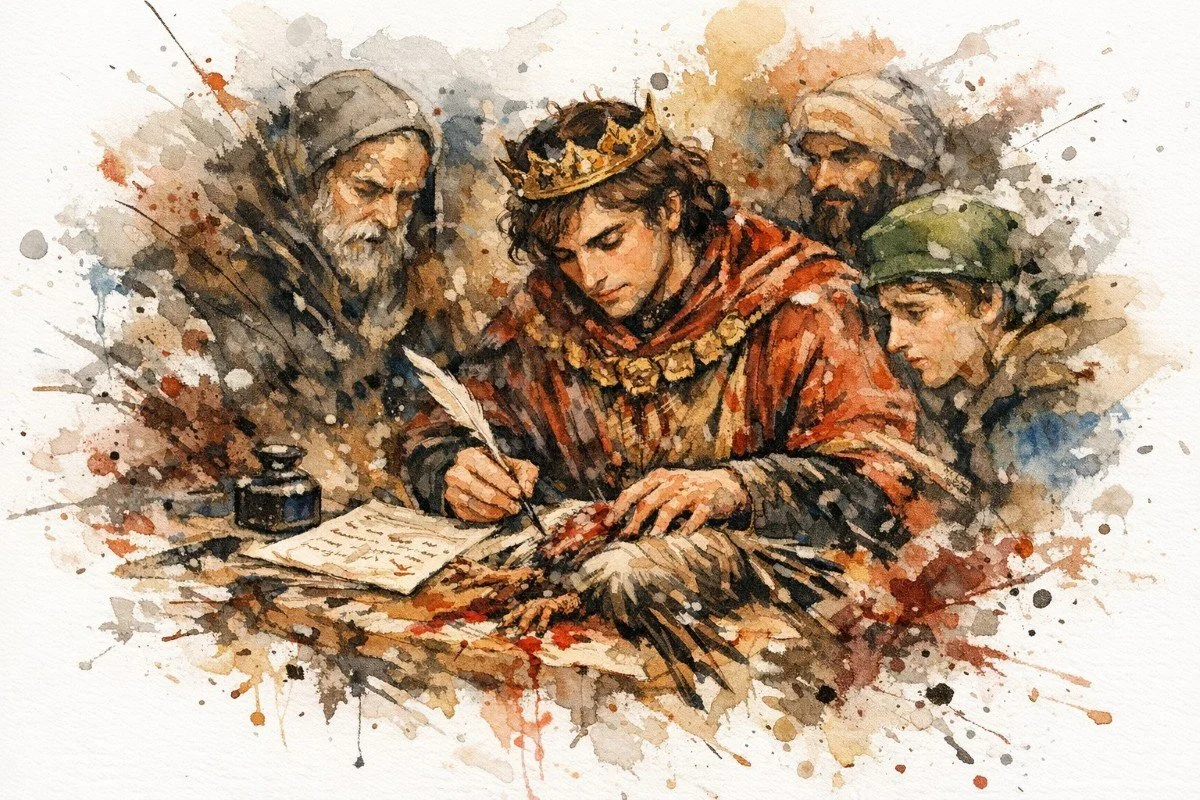
He turned his gaze to creatures, wing and claw,
Observed the hawk that in the azure law
Of flight held mastery, a feathered dart.
No mere delight of chase engrossed his heart,
But keen dissection, patient, steady-eyed,
The inner workings, where life's secrets hide.
The eagle's bone, the falcon's sinew strong,
He charted flight, correcting ancient wrong.
His book arose, a testament so rare,
De Arte Venandi, beyond compare,
Where observation banished myth and guess,
A king's pursuit became a science, no less.
Within his courts, a marvel to behold,
A Noah's Ark, in stories to be told.
The lion paced, with tawny mane of might,
The elephant, a wonder to the sight,
Strange beasts from Afric shores and Asian clime,
Collected there, defying space and time.
He watched their habits, instinct's hidden spring,
A living library, each scale and wing
A source of learning, prompting endless thought,
The universe in miniature was brought
Before his eyes, a tapestry so grand,
Held in the hollow of his royal hand.
Yet whispers rose, like shadows in the sun,
Of ways unorth’dox, of paths begun
That strayed from custom, from the well-worn track.
His keen embrace of knowledge, holding back
No source, no tongue, drew murmurs, sharp and low.
"The Emperor consorts with Saraceno!
His mind explores where Holy writ is still!"
Awe mixed with fear, a sense of rising ill.
They marvelled at his brilliance, sharp and clear,
Yet in that light, found cause for doubt and fear.
For such a mind, that dared to question all,
Seemed set apart, beyond their common call.
Thus in Palermo, 'neath the sun's embrace,
Frederick moved, with intellectual grace.
The "Wonder of the World," in youthful prime,
Whose thirst for knowledge would transcend all time,
A solitary star, in firmament of kings,
Whose light inspired, and yet unease it brings.
For greatness, born of such a singular fire,
Must often walk where shadows darkly lie.
Canto IV:
Crusader King
The weight of vows, a Hohenstaufen strain,
His grandsire's legend, on a dusty plain
Of Anatolia, claimed by Paynim hand,
His father's pledge, unkept in shifting sand
Of mortal years – these echoes did reside
Within young Frederick, a kingly tide
Of expectation, Europe's watchful gaze,
To wrest the Sepulchre from alien ways.
Yet in his breast, a different counsel lay,
Where intellect held passion's fiery sway.
He journeyed forth, not with a zealot's cry,
Nor blinded rage beneath a blood-red sky.
His keen mind charted paths that others scorned,
A parley sought where steel had ever mourned.
With Al-Kamil, Sultan of the Nile,
He spoke of stars, of wisdom's subtle wile,
Of shared humanity beneath the sun,
While Christian swords their bitter work had done
For generations, fruitlessly and long.
Did Frederick smile, amidst the martial throng,
To find an ear that reasoned, understood
Beyond the clash of cross and Kalima's wood?
Jerusalem arose, a prize unsought
By battering ram or fiercely contested fort.
A treaty penned, a pact with reasoned grace,
Restored the shrines, a hallowed dwelling place
For pilgrim feet. Nazareth, Bethlehem,
Returned to Christendom, a diadem
Of holy sites, achieved without the stain
Of slaughter's waste, the agonizing pain
Of siege and storm. Yet Europe held its breath,
And whispers rose, like harbingers of death
To reputation. How could this be won?
No glorious battle, fiercely fought and done?
The Fisherman's successor, old and grim,
Saw not salvation at the city's rim,
But compromise, a dalliance with the foe,
A king's ambition, planted seeds of woe.
Excommunication's thunderous decree
Fell on his head: "A heretic is he!
Who sups with infidels, and makes a pact
Where righteous steel should be the only act!"
Did Frederick scoff, a wry and inward smile,
At such small vision, bound by ancient guile
Of endless war? Could they not see the gain,
The holy places freed from further pain?
Yet some, who saw the ravaged fields of war,
The endless dying, reaching for no shore
Of lasting peace, began to shift their gaze.
Could wisdom lie in unexpected ways?
The men-at-arms, who yearned for hearth and home,
Perhaps admired the peace he'd overcome
Through words, not wounds. But loyalty, a chain
Forged in the fires of tradition's reign,
Held many fast to old antipathies,
While Frederick watched, with cool incredulities,
The slow uptake, the minds that could not leap
Beyond the dogma that their souls did keep.
"Do they not see?" his silent thought might run,
"The folly of a course so blindly run?
To shed more blood where reason could prevail?
Their narrow faith, a ship without a sail,
Adrift on seas of hatred, never free."
He kept his counsel, in his majesty,
A mind that soared where lesser spirits crawled,
Perplexed, perhaps amused, yet standing tall,
A lonely figure on a shifting stage,
Whose vision spanned a more enlightened age,
While those around, in rigid doctrines bound,
Mistook his wisdom for unholy ground.
Canto V:
The Shadow of Conflict
His heart lay southward, where the orange bloomed,
Where Sicily's warm air his spirit groomed.
He dreamt of order, laws that served the land,
A realm united 'neath his guiding hand.
From Naples' shores to fair Palermo's grace,
He sought to build a strong and stable space,
Where arts might flourish, and where reason's light
Could pierce the shadows of the endless fight.
But shadows stretched from Rome's eternal hills,
Where papal ire a bitter venom spills.
"Defiant Emperor!" the thunder cried,
"Whose earthly pride doth heavenly law deride!
He consorts with the Muslim, shares their lore,
His curious mind unlocks a forbidden door!
His menagerie, a bestial display,
Reflects the darkness festering in his way!
He questions truths that holy scripture states,
A serpent coiled within Italia's gates!"
Thus Gregory's voice, a weapon sharp and cold,
Sowed seeds of doubt, in stories to be told,
Twisting his quest for knowledge, pure and bright,
To heresy, a blight upon the light.
And from the north, where Lombard cities stood,
In fierce defiance, nourished by their blood-
Bought freedom, rose a wall against his reign.
They scorned the Emperor's desire to chain
Their proud republics, bind them to his will.
Siege and harsh battle, on each dusty hill,
Consumed his strength, diverted precious gold,
The dream of unity, a story left untold.
For every step towards a settled peace,
New insurrection brought a swift release
Of pent-up fury, fuelled by papal call,
And ancient grudges, poisoning one and all.
Yet in the quiet of his study's keep,
Where scrolls lay open, secrets buried deep,
He found a solace that the world denied.
A scholar's voice, with wisdom as his guide,
Might speak of stars, of nature's hidden laws,
Ignoring for a while the clash of cause
And counter-cause that marked his weary days.
Perhaps a mind that charted cosmic ways,
Or one who sought the secrets of the earth,
Could offer respite, prove of greater worth
Than bickering dukes or cardinals in rage,
A fleeting glimpse of a more reasoned age.
The weight of empire pressed upon his soul,
A constant drain, demanding its grim toll.
The endless strife, the slanders and the lies,
Reflected in his careworn, thoughtful eyes.
He yearned to build, to foster and create,
But war's harsh rhythm sealed a different fate.
The treasures spent on armies, siege, and shield,
Could have enriched the scholar's fertile field.
A bitter irony, a king's lament,
That external storms his best intent
Should constantly disrupt, and leave him worn,
A prisoner of battles, fiercely sworn.
Yet even so, amidst the clash and din,
A spark of progress flickered deep within
His southern lands. New laws, more fairly wrought,
A vision of a future, dearly bought
By constant struggle. Though his foes might sneer,
And paint his wisdom with the stain of fear,
The seeds of innovation, sown with care,
Bloomed in the shadow of his long despair,
A testament that even conflict's night
Could not extinguish his enduring light.
Canto VI:
The Enigma and the Legacy
The years spun onward, battles ebbed and flowed,
The Emperor's brow with lines of hardship showed.
Yet still, his mind, a restless, seeking fire,
Found solace in the stars, and climbed still higher
In realms of thought, where earthly strife grew dim.
But shadows lengthened, drawing close to him.
The final reckoning, a silent, unseen guest,
Arrived at last, and laid him down to rest.
Across the lands, a sudden hush descended,
A chapter closed, an era now was ended.
His foes rejoiced, their long-held grievance done,
While those who knew his brilliance, one by one,
Felt keenly now the absence of that light,
That had both dazzled and disturbed the night.
For who could truly fathom what he held
Within his heart, what stories lay concealed
Behind the keen intelligence that shone?
His motives mixed, uniquely his alone.
Did amusement flicker at the Church's ire?
Or weariness consume his soul's desire
For simple peace, a realm where reason reigned?
His inner landscape, largely unproclaimed,
Remained a mystery, then as it does now,
Interpreted by each, according to their vow,
Their fears, their hopes, the lens through which they saw
The "Wonder of the World," defying every law
Of easy judgment. Cynics saw a cold
Calculator, driven by control.
While others, touched by his enlightened grace,
A visionary soul, ahead of time and place.
His laws endured, in southern lands he loved,
A framework built, on principles he proved.
His patronage, to learning's sacred flame,
Left sparks that flickered, whispering his name
In halls of science, centuries afar.
Yet still, the stain of excommunication's scar
Clung to his legend, a shadow dark and deep,
While fractured Empire sowed the seeds to reap
A harvest of division, strife, and woe,
A consequence his reign could not outgrow.
So history's page, with ink both bright and grim,
Preserves his image, at its very brim
Of comprehension. Was he saint or sage,
Or tyrant cloaked in an enlightened age?
The answers shift, with every passing year,
Reflecting more the reader's doubt or fear,
Their own frail grasp on motives pure or base,
Projected onto that enigmatic face.
For even Emperors, in their lofty sphere,
Remain but mortals, bound by what is dear
And what is loathed, a complex, tangled thread,
Of which but fragments can be truly read.
Thus Frederick sleeps, in legend and in stone,
His singular spirit ultimately unknown.
Awe and dismay, the echoes of his reign,
Through endless corridors of time remain.
The "Stupor Mundi," a title richly earned,
Whose truest thoughts were never fully learned.
A testament to every striving soul,
That even in the grandest, guiding role,
The inner self, a universe untold,
By mortal eyes can never be unrolled.
His legacy, a mirror held to all,
To see their own reflections rise and fall
Upon the surface of a life so vast,
An enigma lingering from ages past.
Epilogue
Hohenstaufen,
Gone the dynasty!
Crown jewels vanished,
No diadem.
Museum curators,
Quite aghast at the
Lack of treasure,
Woe is them!
Author’s Note
c. 3,000 words
I am always intrigued at how some historical figures have been judged with such a range of opinions, and others have been left largely ignored. The 13th century was a pivotal time for medieval Europe’s intellectual curiosity and growth.
It was Frederick’s falconry book which first drew him to my attention. Apparently it was hugely respected, due to its detailed observations and practical guidance. Copies were highly prized amongst the royalty and nobles of Europe.
Some time later I became aware that Frederick’s queen was a sister of King Henry III of England, who had similarly inherited his own throne at a young age and successfully held onto it for several decades. That led me to wondering what other parallels there might have been.