Maximus Leaving Britain
A verse-ballad in hendecasyllabic meter
Strophe I: The Architect’s Prologue (The Education)
Strophe II: The Viroconium Noon (The Stability)
Strophe III: The High Inspection (The Purpose)
Strophe IV: The Contract of the Cup (The Marriage/Sevira)
Strophe V: The Strings of Order (The Music/Aristides)
Strophe VI: The Broken Harmony (Conan’s Entrance/Discord)
Strophe VII: The Herding of the Wolf (The Tactical Response)
Strophe VIII: The Bridge of Wood (The Regularity of the Sea)
Strophe IX: The Rhine Welcoming (The "Flipping" of the Legions)
Strophe X: The Shadow of the Bear (The Tragedy of Ursula)
Strophe XI: The Architecture of the Will (The Aula Palatina)
Strophe XII: The Contented Vicar (The Memory of Valentinian I)
Strophe XIII: The Warning to the Heir (The Fear of History Repeating)
Strophe XIV: The Cold Accord (The Recognition of Valentinian II)
Strophe XV: The High Noon of Trier (The Apotheosis)
Strophe I: The Architect’s Prologue
Deep in granite, the boy had learned the numbers,
Watching hawks dive on hares in Spanish highlands,
Tutors spoke of the shadows cast by Plato.
"Logic," said they, "is light within the darkness."
Now the Boar comes to Britain, cold and steady,
Sees a land that has lost its ancient braids now;
Law and comb have already cleared the chaos.
He is here to inspect the soul of empire,
To apply the Aristidean ratios
To the roads and the walls and signal towers.
Not for glory he sharpens steel for battle,
But for safety of those who sleep in silence;
Pruning vines so the roots will last the winter.
This the footnote before the main text opens
In the halls of the north where marble waits him.
Strophe II: The Viroconium Noon
Here, where Watling Street meets the western mountains,
Marble glows in the steam of the Viroconium baths;
Maximus counts the grain in the cool of the storehouse.
"Number is all," he thinks, while he plots the signal,
Watching the light leap fast from the coastal towers.
Long is the hair forgotten, the braids of the fathers,
Sheared by the law and the comb in the days of old-time;
He knows the Why of the cut and the polished forehead—
Order is peace, and the peace is a gift of the ruler.
Guests at his table speak of the hunt and the hawking,
Lifting the Cup to the health of the distant Caesar;
Maximus smiles, but his mind is a geometric
Map of the roads, and the strength of the hidden cohorts.
This is the noon of his day, and the hills are quiet,
Holding the "Golden Age" in a circle of iron.
Strophe III: The High Inspection
High on the Long Mynd, the wind is a whetstone, sharpening
Eyes that have mastered the maps and the cold math of kings.
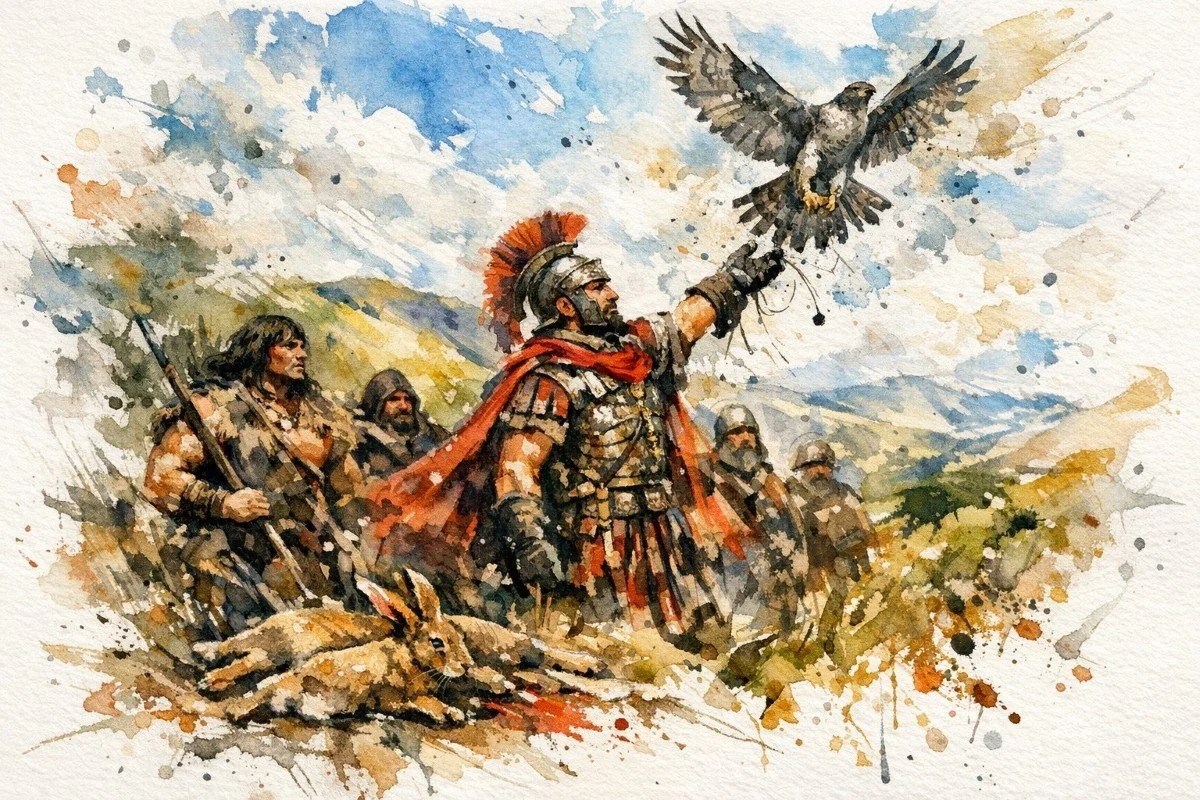
Tethered in leather, the peregrine waits for the word,
Wing-beat and talons—a logic that falls from the blue.
Maximus watches the sky, not for pleasure of blood,
But for the proof that the high lands are held in his hand.
"Soft is the guest who forgets that the table is brief,"
Whites of the frost on the gorse-bush are speaking of change.
He knows the hawk must be hooded when hunting is done;
He knows the Cup must be drained and the hearth-fire go dark.
Down in the valley, the villa is warm with the wine,
But on the ridge, there is only the distance to Rome.
Practical choices are made in the silence of hills:
One cannot stay where the host has no more left to give.
Sovereign and solitary, he loosens the jess,
Letting the Will fly away to a sun in the East.
Strophe IV: The Contract of the Cup
Back in the hall, where the lamps are an amber glow,
Waiting is Merlin, the man of the hidden thought.
"Drink to the daughter," he says with a quiet smile,
"Pour out the Cup for the girl and the Midland-lord.
She is the gold, and the Vortigern is the clay;
Mix them together to harden the western rim."
Maximus nods, for the numbers are matching well:
One wedding ring is a wall that no Pict can climb.
"Conan will sulk," says the sage, with a knowing look,
"Thinking the prize should be his for a raid or two."
"Conan," says Max, "is a child with a braided mind;
He sees the spark, but he knows not the fire’s depth.
Give him the sea and a shore that is far away;
Leave him the dream while we deal with the world of fact."
Thus is the girl made a bridal of iron-law,
Sealing the footnote before the great march begins.
Strophe V: The Strings of Order
"Teach them," whispers the sage, "the Greekan numbers,
Show the Britons the soul is made of ratio;
Let them study the math of old Aristides.
Music tames the unruly mind to order."
Maximus feels a twang of sharp disquiet,
Thinking back to the bards, the ghostly singers,
Hiding deep in the woods where oak trees whisper.
Can the Romanised tongue forget the old songs?
"Plato’s harmony," says the Count, "is higher,
But the blood has a beat that mocks the numbers."
Discomfiture is there, a ghostly shadow:
Under polished gowns, the heart is pagan.
"Give them strings and the law to comb the spirit,
Lest the braids of the past return to haunt us."
Strophe VI: The Broken Harmony
White cloth spreads on the boards, the wine is pouring;
Youths play lyres in the mode of Aristides,
Clear notes ring through the hall of Viroconium.
"Ratio," whispers the Count, "is life’s own fountain."
Sevira sits, the gold in a crown of myrtle,
Vortigern is the clay, the solid guardian.
Yet, there haunts in the strings a ghostly pagan
Twang of oaks and the bards in shadowed forests;
Maximus feels the chill, a dark discomfort.
Suddenly, through the doors, the noise is breaking—
Conan comes with the smell of mud and wildness,
Loudly boasting of blood and "clever" thieving.
He knows not of the math or Greekan numbers;
Wolves will howl when the men are singing order.
Practical is the scowl that kills the laughter:
One must banish the brawl to save the songbook.
Strophe VII: The Herding of the Wolf
Conan, stung by the Cup and wedding myrtle,
Strikes the valleys with "clever" fire and robbing,
Thinking raids are the proof of savage power.
Hellion, he burns the granary doors down.
Maximus does not flinch or break the numbers;
Fast the riders are spurred to Deva’s gateway.
"Move the Boar," says the Count, "and hem the shadow;
Drive the Wolf to the ports and waiting galleys."
While he signs the command for Rhineland crossing,
Eyes of geometry map the line of marching.
One hand deals with the brawler in the mud-track,
One hand reaches for Trier’s marble purple.
Wolves think spinning in circles is a vict’ry;
Kings see lines on the map and closing networks.
Practical is the trap that looks like honour:
"Here is Gaul for your raiding; sail tomorrow."
Strophe VIII: The Bridge of Wood
Blue roads, paved with the salt and foam of Neptune,
Clear tides pulse like a clock in Roman harbours;
This is nothing but paths and regular sailings.
Maximus stands on the deck, a veteran master,
Watching tides that he’s crossed a hundred times now.
"Seaways," says he, "are lines of law and number."
Far ahead is the Wolf, the seasick Conan,
Gripping wood as the world is heave and rolling;
He knows not of the stars or deep-sea charts now,
Feeling small as the land is lost in mist-drift.
Practical is the bridge that spans the Channel,
Carrying Boars to a shore of marble promise.
Old roads lead to the West, but new ones open:
Leave the footnote of hills for Rhineland story.
Strophe IX: The Rhine Welcoming
Mist-white, deep in the mouth of Rhineland waters,
Shield-walls wait for the word of Gaulish masters;
Maximus steps to the shore, the purple blooming.
"Brothers," says he, "the Aristidean numbers
Govern the heart of the man who wears the helmet.
Look now: am I a Goth in Scythian fashion?
Or am I Rome, and the law of Constantinus?"
Fast as the tide, the resentment turns to wonder;
Legions of Germany lower golden eagles.
"Law," they are shouting, "has come to end the brawling!"
Practical is the crown he wears so lightly:
One does not fight when the truth is self-apparent.
Trier is the gateway, the centre of the story;
Leave the old footnote of hills to fade in mist-drift.
Strophe X: The Sovereign of the Shards
Down steps Bear with the Cornish braids around her,
Regal, schooled by the daughter in the pivot;
Speaking words of the Varni from the forest,
Drawing poor and the shattered to her shadow.
Thousands kneel to the hem of Nimue’s garment,
Blind to Wolf and his cold and deadly iron;
She seeks thrones in the hearts of simple people,
Boar gives bride, but a Queen a-boards the galley.
Watching close are the men of Milan’s Bishop,
Dressed in black with the cross of silver gleaming;
"Come to Basel," they whisper through the clamour,
"Leave the soldiers to bleed among the legions."
She hears high music calling from the Alpine,
Sees the Brocard of Law in cleric letters;
Trier calls to the Boar with flags of purple,
While the Bear sets a course for deadly altars.
Strophe XI: The Architecture of the Will
Here stands Maximus, high in the Aula’s marble;
Walls of Trier are towers of cold commandment.
"Kings," says he to the men from the Eastern palace,
"Know their worth by the weight of the stone above them.
Once a boy in the hills of the Gallaecians,
I knew halls of the granite and hidden tunnels,
Where the tutors would whisper of blood and empire.
Then the footnote of Viroconium’s timber,
Where the hospitable cup was a brief delusion.
Now the scale is the Aristidean order,
Vast and empty of songs from the oak and bardic;
I am Rome, and the Law is the highest foundation.
Speak of Theodosius, the Master Eastward:
Does his hall have the depth of a Constantine?
Mine is built on the lines of the true succession."
Strophe XII: The Contented Vicar
Once I served as a Vicar, minding numbers,
Glad to work for the stern and stately Master;
Valentinian held the world together.
I was safe in the gears of Greater Order,
Checking grain-bills and signing off the wax-seals.
But I heard in the whispers of the campfire
How the purple was thrown at men of wisdom,
How the Sallust refused the heavy linen.
Who was left but the one who stood the nearest?
Empire starts in a room where men are waiting;
Not with gods, but a vote of tired soldiers.
I was satisfied then to be the Footnote,
While the Centre was held by iron fingers.
Strophe XIII: The Warning to the Heir
"Heed me, Theo," I said (the younger Theo),
Back when frost turned the British brambles silver;
"Look at Rome and the Year of Four Emperors.
Galba fell, and the Otho bled in silence,
Vile Vitellius choked upon his gluttony.
Is it worth it—the crown that fits so loosely?
Rule has come to the luck of 'Right-Time, Right-Place,'
Not the blood of a Constantine or saviour."
Young and proud, he had laughed at all my stories,
Thinking fate was a thing that he could harness.
But I saw in the dark a shifting shadow:
If the Centre is soft, the Boar must waken.
One must seize it before the brawl of hunger
Turns the world to a wasteland of the useless.
Strophe XIV: The Cold Accord
"Rest," says Merlin, "the lines are drawn in purple;
Theodosius has signed the scroll of partners.
Leave the boy in the softness of the southland;
Valentinian is but a golden shadow."
Maximus reads the script with eyes of gelass,
Knowing well that a child is weak for empire.
"He is 'Augustus' by the grace of mercy,
Not the blood-earned respect of tried and veterans."
Practical is the peace that guards the border:
While the boy-king is playing games in Milan,
Maximus builds a state of stone and number.
One must wait for the rot to show its head now;
One must honour the truce while sharpening iron.
It is better to be the wall that’s standing,
Than a brawler who breaks the hall too early.
Strophe XV: The High Noon of Trier
Sun is high on the marble halls of Trier,
Prosperous is the land of Rhine and Gallia;
This is not a mere footnote, but a story.
Boars are sleeping in barracks, well-fed, steady;
Combed is the hair of the law-abiding citizens.
Maximus looks across the frosty mountains,
Satisfied with the ratio of his doing.
Vicar, soldier, and now the Sovereign Master,
He has tuned the unruly world to order.
Leave the tragedy hidden in the future,
Past the snow and the passes of the Alpine.
For a moment, the Grail is full and heavy,
Held in hands that have mastered every number.
Here is Rome, in the North, at rest and sovereign.
– – – finis – – –
Author’s Note
c. 2,200 words
The Legions of Rome had been occupying Britain for more than three centuries, and there was an established structure and way of things. The new Christian religion had been growing in popularity, and had been adopted by Rome itself. Pagan beliefs were being pushed aside. However, in Gaul and Germania there was a rival faith, as Mithraism spread amongst the people. And the Emperor Gratian mocked Rome itself, by choosing to wear the rough skins of the Alan tribes, and being supported by a retinue of Scythian bowmen.
Maximus was the last commander of the Roman Legions to be based in Britain. His childhood and education were in Spain. To have risen through the ranks, he must have been from an important family, but later events led to his story being scrubbed from the official records. He also, must have excelled at both physical and intellectual skills, as the Roman Empire was a tough and demanding place where weakness would soon be crushed.
A little explored hypothesis is that Maximus was perhaps an illegitimate descendent of the Constantinian bloodline. Such heritage would have provided strong reasons for other families to want to keep him away from Rome. It also would have stirred up strong passions in his loyal soldiers, who saw first-hand the Western Empire’s decline in recent decades. This poem accepts the premise of the hypothesis, making Maximus compelled to follow his destiny of saving Rome.
Other historical characters vary in their levels of authenticity. Welsh legends have Maximus’s daughter Sevira wed to Vortigern, first king of the Britons after the Roman withdrawal, but there are very few pieces of reliable evidence. The barbaric raider Conan is also a character whose name has been widely mentioned in past histories, but not with much supporting proof. Saint Ursula is yet another character who seems to have no tangible roots. Ambrose of Milan was the clearest to research, and understanding his ambitions has helped to balance the narratives of the events and participants while synthesizing a pathway through the known facts.