Trent and Mersey Canal
Canto I: The Reign and The Vision (c. 1751–1766)
The year is Seventeen-Hundred-Fifty-One,
The Georgian line had faced a sudden gun.
Not shot on field, but from a cricket ball,
Poor Frederick, Prince of Wales, had made his fall.
A chill, a burst abscess, at Kew he caught his breath,
And twelve-year George was jerked from play to death.
The heir apparent, stripped of farmyard charm,
Replaced the lambs of Richmond for the Crown's alarm.
His grandfather, the Second, held the throne,
A King of Hanover, of Germanic stone.
But George, the Third, declared a different law:
"Born and raised in this country, I glory in the name of Briton!" raw.
He sought domestic solace, shunning vice,
His Queen, Charlotte, his partner, chaste and nice.
He purchased Buckingham House in sixty-one,
To mark a simple court, his German age undone.
Across the seas, the Townshend Acts were sown,
A seed of bitter strife the King had owned.
Lord North, the Minister, was slow to care,
His gaze upon the colonies, heavy with despair.
The Falklands, Ireland, and a nation's debt,
The long, slow fuse of Revolution set.
But while the Empire fissured, vast and wide,
A quieter ambition stirred deep inside.
For now, the Crown financed a different quest,
To map the Terra Incognita of the West.
A humble ship, Endeavour, sailed in 'sixty-eight,
To watch the Transit of Venus, charting fate.
So Cook explored the globe, for science and for fame,
While back in England, others sought the game—
A new, domestic Empire, forged of steam and clay,
Where inland waters opened up a hidden way.
It was Wedgwood, the Potter, who first raised the cry,
"My brittle wares are fractured 'neath the sky!
The bumpy road, the packhorse, breaks the yield,
We need a smoother path from china clay to field!"
He met with Brindley, rough-hewn, wise, and keen,
The Millwright-Engineer, a Northern scene.
Their vision, the Grand Trunk, a Cross of water-steel,
To link the four great rivers—that was the new seal!
Canto II: The Grand Trunk's Birth
(Construction and Vision: c. 1765–1766)
The vision was declared, but land was held by few,
The Parliament was deaf to trade, to what industry could do.
Then stepped a nobleman, with interests vast and deep,
Earl Gower, a landlord with promises to keep.
He lent his name, his weight, his mighty Trentham Hall,
To house the Wolseley Bridge assembly,
Where the gentry would convene to answer freedom's call.
He sought Wedgwood's commitment, the salt lords’ final purse,
To tame the rival routes and lift the ancient curse:
For transport cost nine shillings where the packhorse went its way,
The canal men promised three, and swift delivery in a day.
The self-taught Brindley, known for daring mind,
Had proved his worth on Bridgewater's narrow kind.
The Duke gained fame and riches, but the engineer learned well:
To sell the grandest dream, the simplest tale to tell.
So Brindley took a Cheshire wheel of cheese,
And carved a working model that brought them to their knees.
He showed them how a channel could cross a river high,
A Barton Aqueduct beneath the open sky.
He was hired by the partners, and the final plan unfurled,
To build the Grand Trunk Canal, connecting half the world.
The Act of Parliament was passed in sixty-six,
To launch the nation’s greatest work of brick and sticks.
The final cost was reckoned at £300,000 gold,
A sum colossal, braver than stories ever told.
In Burslem, Wedgwood himself stood proud that day,
And took the ceremonial spade to cut the first sod of clay.
A symbol of the shift, from King and Court to Trade,
The Industrial Revolution's first, great road was laid.
The work began where the land was broken hardest,
The chosen route demanded all the art it cast.
For Brindley, frugal, with a wisdom born of clay,
Designed the narrow path, seven-foot, the cheapest way.
Though barges of the Mersey, wide of beam, could fly,
Their bulk was blocked by tunnels, standing centuries high.
From Trent's wide mouth at Shardlow, the first stretch ran broad and deep,
A compromise with river traffic that the Company would keep.
But at Preston Brook and Burton, the broad ways ran their end,
And every journey westward on the narrow boats must bend,
A choice of size that spoke of rival visionaries' pride,
A lasting legacy of two canals that ran side-by-side.
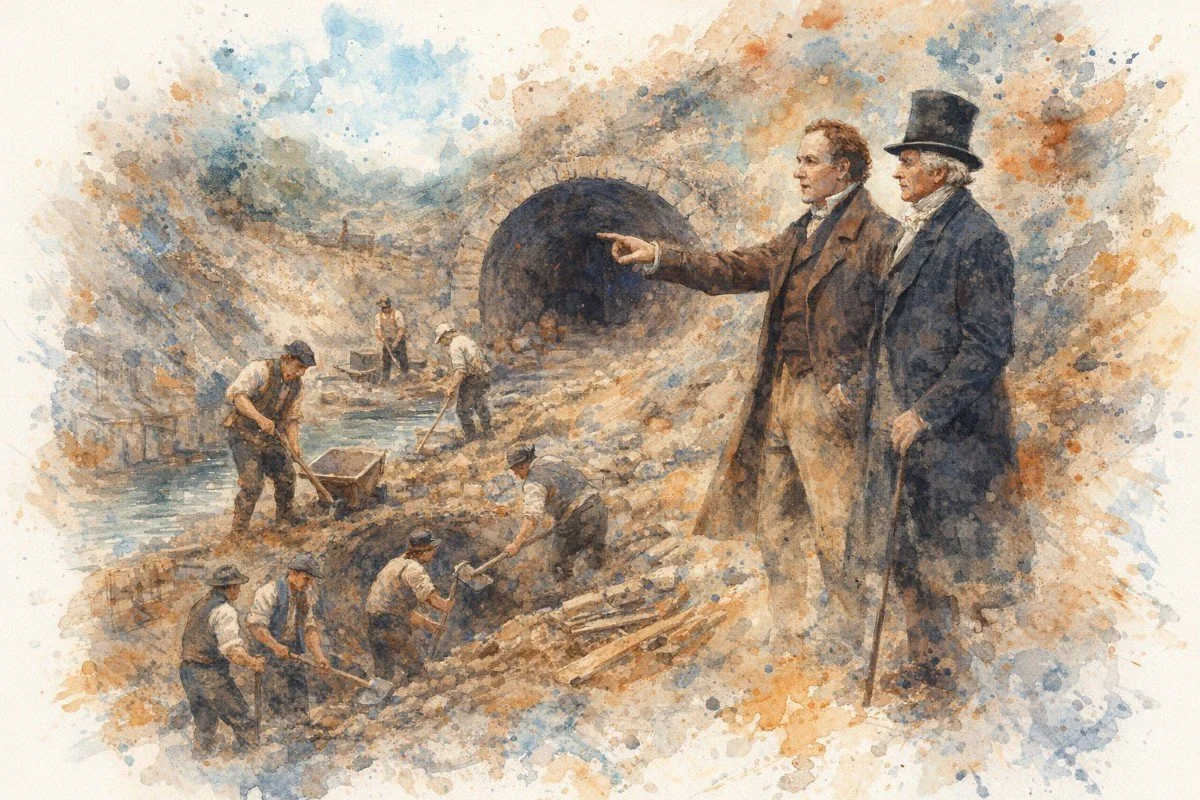
Then came the Summit Peak, where Kidsgrove faced the cloud,
The heart of Harecastle Hill, beneath a coal-dark shroud.
The master plan required a mile and three-quarters long,
The longest tunnel ever built, the subject of a ballad's song.
Brindley drove fifteen shafts to pierce the living rock,
Where navigators dug, enduring every shock.
Through coal seams, quicksand, and the choking, damp, hot air,
They clawed the tunnel forward, fuelled by ale and prayer.
The rough, unlined cavern, nine feet at its span,
A grim, dark corridor, defying God and man.
Brindley died in 'seventy-two, before the final bore,
But his brother-in-law, Hugh Henshall, brought it to the shore.
The work was finished in Seventeen-Seventy-Seven,
But the hardest journey found no path to heaven.
With no bank for the tow-horse, which was led across the hill,
The bargemen knew their labour, the brutal price of skill.
They lay on the cold roof, deep within the black,
And walked their stockinged feet along the rock-hewn track.
The "leggers" strained and pushed, to gain three yards a minute's toll,
Three arduous hours of darkness for the passage of the soul.
A massive, bottlenecked price that commerce had to pay,
A human cost extracted daily, at the light of every day.
But south of that dread tunnel, where the Cheshire climb began,
Our forebears watched and waited, following the plan.
Where Middlewich sent salt and brine across the land,
A chain of thirty-one locks awaited the tough hand.
At Hassall Green, the summit of the endless, rising flight,
The Top Lock, Number Fifty-Seven, marked the bitter night.
Mine own ancestor, the landlord of the Red Lion Inn,
Saw where the route might settle, and where the trade would spin.
He pressed the proprietors, with argument and wit,
To bring the thirsty commerce close—he argued for his bit!
He won the local battle, through persistence and through gold,
To place his tap-room door where weary crews could be consoled.
The chandlery of ropes and tar, the stables for the beast,
Bespoke the rise of industry, from West unto the East.
For now the Grand Trunk opened, wide or narrow, slow or fast,
The flow of coal and pottery ensured the wealth would last.
Canto III: Prime and Decline
(The Commercial Age: c. 1777–1950s)
The great machine was running, the Grand Cross system spread,
The nation thrived on coal and salt, the living and the dead.
But Harecastle's dark dimensions soon proved too small and tight,
A bottleneck of boats that stretched from morning into night.
The profits of the Company, though steady, begged for more,
And summoned Thomas Telford, the Scottish engineer of lore.
He drove a second tunnel, wider, straight, and clean,
A feat of modern brickwork, a towpath placed between.
No legging now, but horses hauling cargo through the damp,
Telford relieved the blackness, and struck away the lamp.
Yet still the hardest labour was the endless, watery stairs,
The Cheshire locks demanded sweat from endless boatman pairs.
The Thirty-One from Middlewich to Kidsgrove's northern rise,
A sheer, exhausting gradient beneath the northern skies.
The crews would walk the towpath, with muscle and with might,
And battle heavy balance-beams from sunrise deep to night.
The flight became a legend of the narrowboatmen's strain,
The weary, slow ascension earned the name of Heartbreak Hill again.
But faster steeds were coming, upon the iron road,
The railway's sudden promise relieved the water-load.
By eighteen-fifty, traffic found the locomotive's speed,
The canal's great utility was waning, lost to greener greed.
The Company was threatened, their profits ceased to climb,
The steady freight of pottery was taken back by time.
The narrowboats still travelled, through the years of smoke and war,
Carrying coal and Burton's famous beer, but ever less and more.
The electric tugs assisted, a final, vain attempt to cope,
But by the mid-twentieth century, the great trade lost all hope.
The commerce dwindled slowly, the wharves grew overgrown,
And in the nineteen-fifties, the canal was left alone.
Canto IV: Education and Endurance
(Rebirth and Heritage: c. 1870s–Present)
The great boatmen’s age, which ran so proud and long,
Began to yield its people to a different song.
For Parliament, in the year of Eighteen-Seventy,
Passed an Act (for England) requiring education to every child, and free.
The inn-keeper’s widow, by the fading lamplight stood,
And saw her grandsons taken from the towpath for their good.
No longer bound to alehouse, boat, or windlass rough,
They trained for other trades—they had endured enough.
The Red Lion's profit faded, the family tie withdrew,
The silent Lock was left to greet the passing of the few.
By the Eighteen-Nineties, the door was locked at last,
And the stone of Lock Fifty-Seven watched the shadows cast.
The old canal, this giant built of clay and strain,
Was slowly sinking back to field and winter rain.
The Brindley Tunnel, weakened by the tremors from the rail,
Collapsed and closed forever, the old black, narrow trail.
Then, by the Nineteen-Sixties, the entire length lay low,
A relic slowly silting, where no commercial boat would go.
But in the halls of power, a slow thought started growing,
That the past's great working relics were a heritage worth knowing.
The state decreed by Act of Parliament its care,
To save the ancient waterway from ruin and despair.
Yet not with King George’s treasury, or Brindley's millionaires,
The massive task was handed to a different set of heirs.
The enthusiast, the volunteer, with passion as their guide,
Took up the winding gear upon the old towpath side.
The Canal Trust raised the money; the patient hands were found,
To save the bridges, mend the banks, and dredge the shallow ground.
They lack the Georgian gold, the power of command,
But bring a new devotion to this great and furrowed land.
And so the long, laborious staircase, Heartbreak Hill's steep face,
Is worked by holiday-makers, in a leisurely new pace.
The narrow locks admit the pleasure craft in line,
And at the top, the massive stone is still the great design.
The inn is now a quiet house, the coal barges are gone,
But the water flows eternally, from dusk till rising dawn.
From Trent to Mersey, North to South, the path remains today,
A preserved monument to purpose, carved in stone and clay.
It stands a true, enduring epic, beneath the sky's vast dome,
The lasting legacy of Britain's will to bring the riches home.
– – – finis – – –
Author’s Note
c. 1,800 words
There are many marvels of 18th century British engineering endeavor, and the programme of canal building is surely amongst the most impressive in scale. The network of canals criss-crossed the landscape to link the industrial cities with the ports and drastically reduce journey times.
Planning and constructing the routes was a major strategic challenge, which required energy, goodwill, and lots of money.
Later developments saw the arrival of the railway system, which cut journey times even further, leading to the canals’ disuse. They later became a heritage and tourism attraction.
Author’s Note