Ursula and Conan
Movement I: The Choice of the Birds
In the dark of the mews, the hoods are lifted;
Merlinus, with the hawks of stately fashion,
Calls the three to the bench of branch and feather.
"Birds," says he, "are the thoughts of God in motion;
Choose the one that shall wear your golden jesses."
First the child of the Boar, the calm Sevira,
Takes the Tiercel of Law, a steady hunter,
Fit for fields where the Rome of old is guarded.
Next the Wolf, with a hand that shakes in hunger,
Grips the Falcon of Storm, a restless creature,
Wild as waves that have broke the northern harbours.
Last, the Bear with the braid of Cornish crimson,
Ursula, with a mind of deeper numbers,
Takes the Merlin—the small and ghostly killer.
"Small," says she, with a voice that mocks the master,
"Yet it flies where the heavy hawks are blinded."
Movement II: The Flight of the Smallest Wing
Upward, wind from the west is beating fiercely;
Conan, holding the Falcon, slips the blinder.
"Kill!" he cries, with a voice of youthful thunder,
Sending steel to the clouds to prove his valour.
High the hawk is aloft, but breaks the circle,
Lost to blood and the lure of wilder preying;
"Stay!" calls Merlinus, "heed the master’s calling!"
But the Wolf is adrift in passion’s fit now.
Ursula, with the Merlin on her jacket,
Does not shout at the sky or beat the gloved
Hand on hip; she is humming songs of Cornwall,
Small and sharp is the pitch of native music.
Sudden, streak of the ghostly wing is falling,
Striking true where the heavy Falcon faltered.
"See," says she to the Wolf who stands in silence,
"Strength is nought if the brain cannot find timing."
The Imperial Echoes
I. The Fire at Adrianople (378 AD)
Far in the Eastward the sky is aglow with the burning of legions;
Valens is fallen in ash where the Goths have devoured the order.
Maximus reads the dispatch by the light of a flickering candle,
Folding the parchment in silence and hiding the depth of the failure.
"Eastward is shattered," whispers he, looking across at the water,
"Now must the West be the wall for the Rome that is fading to shadow."
II. The Vanity of Gratian
Gratian is wearing the skins of the Alans and hunting the red deer,
Mocking the spirit of Rome with his Scythian bowmen and trappings.
Legions are muttering deep in the mud of the Rhine border ramparts,
Feeling the slight of a master who favours the wilderness savage.
Maximus hears the discord in the song of the soldierly barracks,
Waiting for moment and mathematicianly timing to strike now.
III. The Throne of Ambrose
Ambrose is building a kingdom of spirit in Milan the frosty,
Clashing the keys of the Heaven against the blunt steel of the Empire.
"Kings are but mortals," he cries to the crowd from the steps of the altar,
"Law is the servant of God and the Master is clothed in righteous."
Maximus knows that the bishop is combing a web that is larger;
If one would rule, one must first be the lord of the soul and the number.
Movement III: The Mews Dialogue
Maximus walks in the cool of the garden,
Watching the three as they move in the sunlight;
"Tell me," he says to the Keeper of hunters,
"How has the schooling of Viroconium
Shaped the talons and wings of our children?
Years have gone by since the choosing of jesses."
Merlinus strokes the soft breast of the Merlin:
"Bear-child has learned the tongues of the Germans;
Ursula hunts with a brain that is colder,
Keeping her counsel and braiding her purpose.
She is the hawk that shall fly past the border.
Child of the Boar, our Sevira, is steady,
Guarding the hall with the peace of the number;
She is the cup that is full of the tradition."
He pauses, looking where Conan is striding,
Fist on the hilt of a blade that is restless.
"Wolf is a fire that waits for the dry wood;
He has the strength, but he lacks the Aristides.
He is a blade that needs whetting on Armorica.
Think of the Vortigern—he was the first-born
Sent from your hand to the shadow of ruling;
He learnéd the letter, but lost the high music.
These three are sharpened better than he was,
Yet they are tangled in cords we have knotted."
Movement IV: The Triple Command
I. The Anchor (Sevira)
Now is the day of the wedding, the daughter is bound to the Altar;
White is the robe of Sevira, the cup of the house is now settled.
She shall remain in the land as the root of the Roman tradition,
Holding the hearth while the Boar leads the legions away to the sunrise.
Maximus blesses the couple with prayers for a bloodline of order,
Sealing the British foundation before the great crossing begins now.
II. The Iron Comb (Conan)
"Go then, O Wolf," says the Master, "and clearen the road to the water;
Burn out the nests of the raiders and humble the lords of the hill-forts.
Let not a braid be unravelled before you have reached the embarking;
Sport as you will with the rebel, but leave me a province of silence."
Conan is laughing in darkness, his heart is afire for the carnage,
Seeing the pathway to Armorica fenced with the heads of his enemies.
III. The Gilded Bridge (Ursula)
Ursula stands in the shadow, her face is a mask of the marble;
"You are the peace-pledge," he whispers, "the gift for the kings of the Varni.
Cross you the channel with Conan and sail to the mouth of the river;
Win me the flank of the Germans and guard you the gates of the Empire."
She is the coin of the dealing, the daughter of Cornish dominion,
Paid to the gods of the border to purchase the crown for the Architect.
Movement V: The Departure at the Mews
Sun is breaking the mist of Viroconium;
Conan mounts on a stallion black as midnight,
Looking back at the hall of stone and number.
"Free!" he shouts to the wind that scents of slatter;
"Rome is leaving the woods to Wolf and hunter!"
Maximus watches the dust of rampage rising,
Knowing well that the Wolf will comb the wildlands,
Savage sport for a state of cleaner borders.
Ursula moves to the litter draped in purple,
Whispering to the Merlin on her wristlet:
"Wolf may ravage the earth with fire and hilting,
But the Bear knows the paths the stars are hiding."
Merlinus nods to the girl of Cornish braids now:
"Fly," says he, "for the jesses all are broken."
The Logistics of the Will: Imperial Orders
I. The Wax and the Seal
Swiftly the orders are carved in the wax of the tablets of office;
Haste is the habit of Rome where the Legions are swift in the moving.
Nothing is strange to the Centurions packing the grain and the gear now;
High-priority marches are routine in days of the border.
"Move to the coast," says the script with the seal of the Dux in the purple,
"Rhineland is calling for iron to steady the gates of the Empire."
II. The Rhythm of the Road
Ten thousand boots on the paving of roads that were built for the conquest;
Watling and Foss way are ringing with iron and the beat of the number.
Baggage is loaded and horses are shod for the crossing of water;
Annona grain is accounted by clerks with the pens of the census.
Maximus guards the design while the soldiers are heeding the trumpet,
Seeing a deployment of state where the Architect plans an invasion.
The Rampage to the Coast
Dust rises high on the hills of Gwynedd;
Conan gallops with fury of fire and steeling,
Leading warbands of youth who are hungry for plunder.
"Smoke!" cries the Wolf, as he levels the gate of the rebel;
"This is the pruning that cleanses the land for the Master!"
Women are weeping in shadows of burning rafters,
While the Wolf is a-laughing at heads on the spearpoint.
Ursula watches the glow from the silk of her litter,
Hearing the rough music played by the sword on the shield-rim.
"Wait," says she soft to the captive who cringes in terror;
"Bear has a mercy the Wolf and the Boar have forgotten."
Movement VI: The Logistics of Departure
Now at the port of Rutupiae, galleys are waiting in number;
Iron and timber are groaning with weight of the empire departing.
Disciplined boarding of soldiers in ranks like the waves of the ocean,
Nothing is left to the chance while the Boar is the master of timing.
Ships for the legion are stately and deep with the wheat of the province,
But at the edge of the wharf is a crowd that is singing and praying—
Brides of the land and the orphans of fire whom the Bear has collected.
Chaos is dancing in braids while the legions are marching in silence.
Movement VII: The Private Ambitions
Conan’s Secret Song
"I am the Wolf of the salt-spray and carnage,
Claiming a kingdom of forests and valleys.
Maximus gives me the keys to the West now;
Armorica shall be tilled by my iron.
Once I have settled the coast with my warbands,
Ursula stays as the prize of my hall-light.
She is the garland I won by the ravage,
Tamed by the Romanized purple I’m wearing.
Let her have pilgrims to silence her weeping;
Soon she will honour the Wolf as her master."
Ursula’s Secret Arithmetic
"I am the Bear with the mind of the hawk-mews,
Seeking the sovereign path of the spirit.
Conan is blind to the web I am weaving;
He sees a bride, but I see a deliverance.
These thousand voices are more than a dowry;
They are the shield of the 'Nimue' defector.
I have the Germanic tongue for the Varni,
And the 'Sly Ambrose' is waiting at Basel.
Let the Wolf howl at the moon of his conquest;
I shall be free in the mist of the river."
Movement VIII: The Static Journey
Back on the chalk cliffs, the married are staying;
Vortigern walks with the child of the Empire.
Theirs is a journey that moves without moving,
Keeping the hearth while the stories are sailing.
"Look," says the bride to the man of the letter,
"Waves carry Father away to his glory,
But we are rooted in soil and tradition.
We are the ghostly remainder of Rome now."
Vortigern nods with the weight of his schooling,
Learnéd from Maximus, cold and substantial:
"Stay in the hall while the Boar hunts the purple;
We are the guards of the silent foundation."
II. The Architecture of the New World
I. The Shadow of the Cathedra
Now does the Church of the Christ-child gather the reins of the Empire;
Bishops are sitting in judgment where prefects once lettered the order.
Ambrose is lord of the word and the spirit in Milan the frosty,
Driven by mission from God to be master of kings and of legions.
By him is Marcellina, the sister of silence and hardness,
Guarding the grain of the soul while her brother is combing the statecraft.
She is the archer of Virtue who watches the pride of the worldly,
Waiting for Nimue to stumble on brocards of law and of power.
II. The Liquid Road (Cologne to Basel)
Upward the Rhine is a torrent of grey in the mist of the winter;
Oars are a-beating against the fierce heart of the Alpine descending.
Cologne is the gate of the North where the Boar has his station and barracks,
But at the confluence southward lies Basel, the threshold of Milan.
Peace must be bought at the checkpoints with letters and seals of the bishop;
Not by the sword of the Wolf, but by permits of clerical order.
Ursula navigates water and doctrine with Merlinus' schooling,
Seeking the audience hall where the Sleight of the Hand is awaiting.
Movement IX: The Threshold of Milan
Cold is the wind from the Alps as it beats on the stones of the Basel;
Here is the gateway of Milan, the threshold of clerical power.
Ursula, wearing the braids of the Cornish, is seeking the audience,
Leading the meek-hearted Cordula into the hall of the silence.
Marcellina is waiting in shadow with bread and the water,
Testing the pride of the world with the hardness of holy denial.
Ambrose is gathering shadows to shroud the design of his statecraft,
Waiting for Nimue to speak and to shatter her claim with a whisper.
Movement X: The Meagre Bread and the Brocard
"Is this the bread of a bishop’s hospitality?"
Ursula asks, with a laugh that bites the silence;
"Sour is the crust and the cup is thin with water.
Surely the Boar in his Trier has better vintage?"
Marcellina, in the coarse and humble tunic,
Does not reply, but she marks the cost of splendour.
Cordula trembles and breaks the loaf in meekness,
Blessing the salt that the Bear has scorned proudly.
Ambrose moves from the gloom with smile of marble:
"Child," says he softly, "the soul is fed by fasting.
Tell me why do the thousand seek a freedom?"
Ursula stands with the pride of Viroconium:
"Quod omnes tangit," she quotes the Roman brocard,
"By the law, I am sovereign of the Shards now."
Ambrose nods as the trap is set with honey:
"Law is a servant of Peace," he whispers gently;
"Safety lies in the gates of old Cologne now.
Go you back and the Church shall be your witness."
Movement XI: The Fog of the Rhine
Grey is the mist of the Rhine where the river is heavy with winter;
No-one can see the horizon, the eye is a prisoner's shadow.
Suddenly, prows of the galleys are breaking the white of the curtain,
Bearing the Bear and the pilgrims away from the Alpine promise.
Hard is the sound of the hooves on the paving of Roman Cologne now;
Conan is back from the West with the smell of the smoke on his leather.
Only when bridge-beams are creaking they see the design of the other;
Fate is a ghost in the fog till the hand is at hilt of the weapon.
Movement XII: The Tense Reunion
"Why is the prow of the Bear-ship turnéd?"
Conan asks, with a hand on the pommel;
"Westward is won and the gates are open;
Why do you steer for the frost of the North now?"
Ursula smiles with the Sevira-twist now,
Leaning her head as she did in the Mews-hall:
"Ambrose has blessed the way of the Cross, Wolf.
High is the mission and deeper the number;
Safety lies in the strength of Cologne’s walls.
We are the guards of the Church’s honour."
Conan is muddy and sour with killing,
Seeing the 'Oddity' rise in the people;
Thousands are kneeling to touch at her garment,
Ignoring the Wolf and his bloody trophies.
"I have no brocards for Bishops," he mutters,"
Only the sword for the land Armorica.
Boar will not like this change in the sailing;
Contract is broken by hymns and by shadows."
Movement XIII: The Threshold of the Unlocked Gate
Looms now the gate of the City, the stone-work of Claudius rising;
Gilded the bridge of the entry where soldiers are silent and watchful.
Ursula stands at the prow with the Merlin aloft on her wristlet,
Seeing the doors of the fortress are swinging to welcome the thousand.
"Ambrose has spoken," she whispers, the "Sleight of the Hand" is her cover,
Trusting the brocard of Law to be shield and the wall for her people.
Cordula prays in the shadow, the meek-hearted daughter of Mercy,
Knowing that cities of mortals are built on the shifting of sand-drift.
Movement XIV: The Wolf’s Instinct
Conan sniffing the air of the river,
Feels the "Twang" of the trap in his marrow.
"Why are the guardsmen leaving the turret?
Why is the wharf-side hollow of greeting?"
He has rampaged through the Armorica,
Killing by sight and not by the letter;
He knows the smell of the hunter in hiding,
Waiting for prey to enter the kill-zone.
"Ursula!" calls he, "the gate is a moulting
Waiting to swallow the Shards of your glory!
Turn back the oars to the salt of the West now;
Bishops give blessings, but Boars give the carnage!"
Ursula laughs with the Sevira-pride now:
"Law is my garment and Ambrose my witness;
Wolf is too fearful of ghosts in the shadow.
Enter the gates for the triumph is waiting!"
Movement XV: The Socratic Completion
Heavy the sound of the iron is falling in grooves of the gateway;
Bars of the fortress are dropping to lock in the Shards and the Bear-child.
Out in the reed-beds the bowmen are waiting with notches of venom,
Sent by the "Safety" of Ambrose to finish the work of the order.
No-one is shouting in battle, for this is a matter of Census;
Cleaning the map of a Nimue who thought she was lord of the Brocards.
Ursula looks to the wall-top and sees not a soldier of Trier,
Only the shadows of clerics who watch while the "Music" is ended.
Movement XVI: The Wolf’s Choice
"Gates are closed," says the Wolf in a whisper,
"Bear has walked to the teeth of the Boar now.
I have kingdoms to carve in the Westland;
I cannot die for a ghost in a garment."
He turns head of the stallion to seaward,
Leaving the 'Nimue' to drown in the river;
One last glance at the braid of the Cornish,
Then he is gone to his forests of Armorica.
Ursula holds to the hand of the Cordula,
Seeing the Brocard is torn by the coldness:
"Ambrose has won with a smile and a breadcrust;
We are the Fixed Constant of the Altar."
Movement XVII: The Hollow Dispatch
Letters are coming in silence across the grey salt of the channel;
Seals of the Boar are yet pressed in the wax of the stately dispatches.
Maximus writes of the Trier, of gold and the Alpine procession,
Promising order and legions to follow the turn of the season.
But in the barracks is empty the sound of the Romanized grinding;
Watling is silent of iron and Fosse is a memory of shadow.
Theirs is the "Anchor" of Britain where Rome is a ghost in the garden,
Keeping the "Small Text" of ruling while Main Text is shattered by bishops.
Movement XVIII: The Council of the Shadows
Sevira watches the Child of the letter;
Vortigern studies the map of the empty.
"Father is sailing to Rome and to glory,
But we are guards of a house without masters.
Who shall I call to the bench of the Viroconium hall when the Scotti are raiding?
Kings of the North and the lords of the hill-forts
Heed not the seal of a Dux without legions."
Sevira touches the hand of the husband:
"Use you the schooling that Merlinus gave you;
Summon the Council and speak as a Roman.
If you are weak, then the story will hate you;
'Vortigern' name shall be cursed by the poets,
Architect failure in days of the darkness."
Vortigern looks at the hawk-mews in silence:
"I was the first of the Boar’s own experiments;
I have the number but lack the high music.
If I bring Saxons to bolster the border,
Poets will write me as traitor to Britain.
Yet, I must rule by the standards of Maximus."
– – – finis – – –
Author’s Note
c. 3,300 words
The early medieval folklore relating to the martyr Saint Ursula is not supported by factual research, and the Catholic Church no longer recognises her as one of its official saints. Her mythology was that she supposedly was one of a thousand virgins who drowned in the waters of the Rhine. However there certainly was a cult of virgins in the 4th century, and the city of Trier (modern Cologne) was a major city overrun with refugees from the uprisings and raids of the wider region.
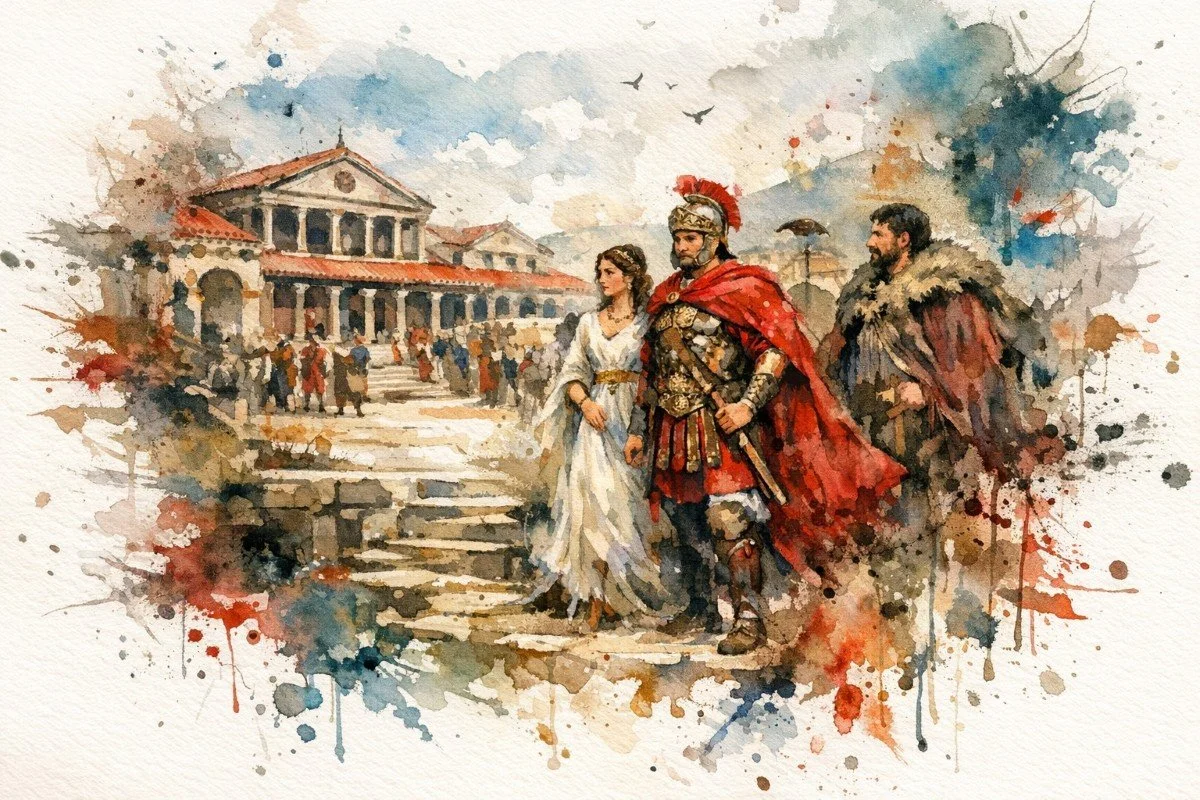
To assist the narrative, I have imagined Ursula as the daughter of a British tribal chieftain, taken into the guardianship of Maximus as a companion for his daughter Sevira. That allows her to receive an elite formal Roman education at Viroconium, and first encounter some of the other characters. As Sevira grows into an accomplished stateswoman, Ursula learns the craft and cunning to manipulate the soldiers and high-ranking dignatories. She also has access to the best materials and is able to learn about pre-Roman tribal histories, including forbidden knowledge of the Druids, which she secretly shares with others. She aspires to reinstate the old ways, seeking to model herself on the fabled Nimue.
Conan too has little factual supporting evidence, despite his regular appearance in folklore. I have therefore chosen to portray him as another child of a tribal chieftain, graced with the benevolence of Maximus’s attempt at schooling, but not abandoning his raw wildness. Conan is a counterweight to Vortigern, who is seen as fit to lead, whereas Conan is lacking finesse and is too hot-headed.
I have interspersed the main narrative with occasional digressions into the broader socio-political climate of the era. Those verses have a deliberate change of meter.